
Course 18 — DISSERTATION BY DOING
Get unlimited access to all learning content and premium assets Membership Pro
🎓📝 Dissertation by Doing — From Research Idea to Complete Dissertation
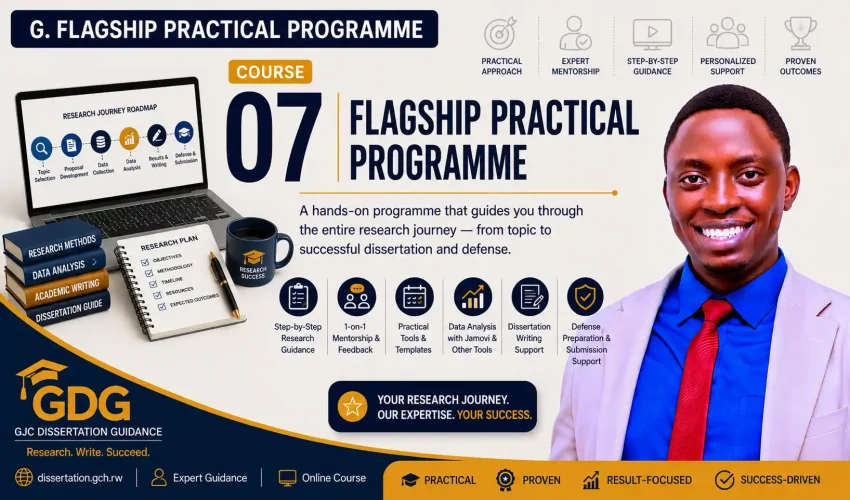
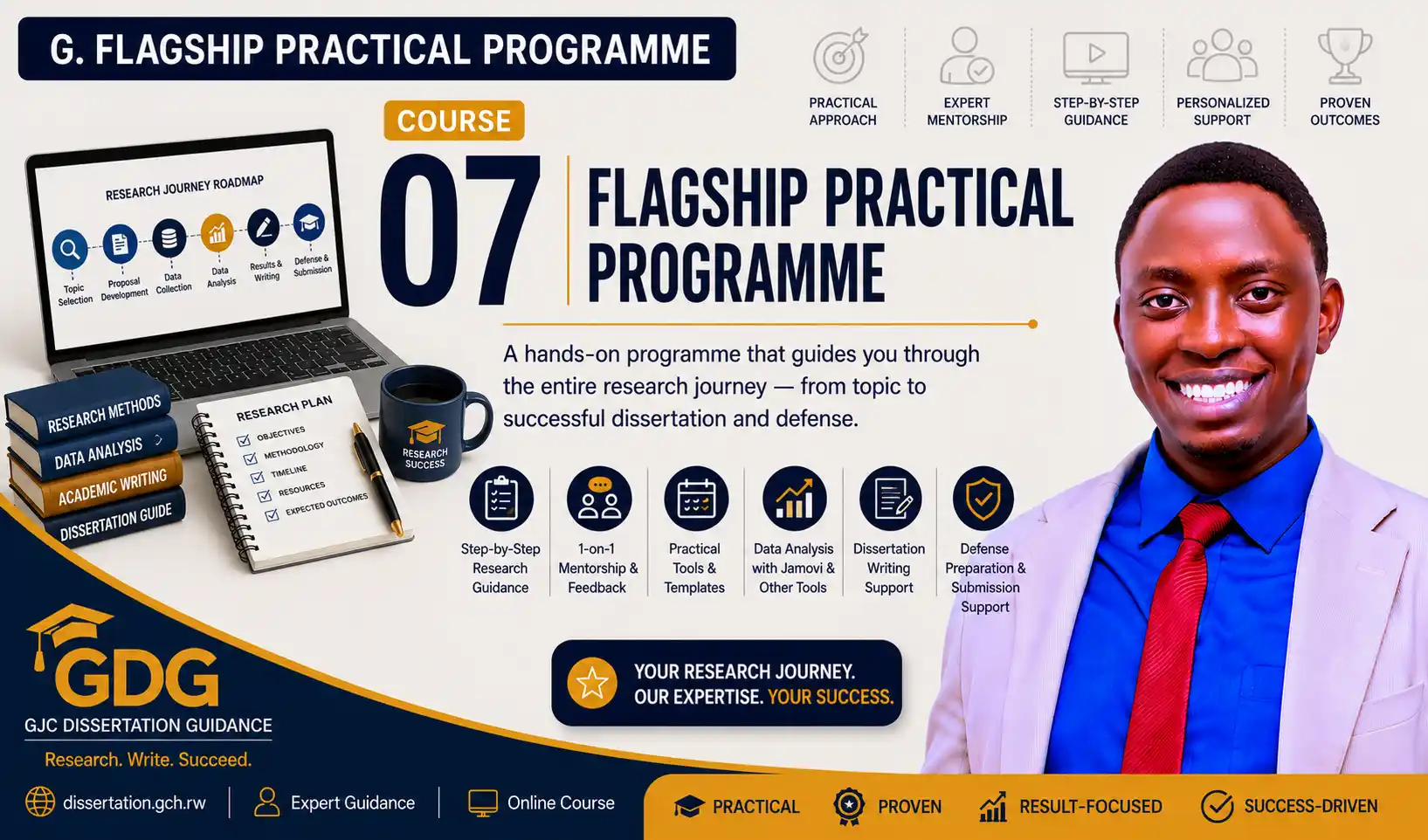
Welcome to Dissertation by Doing, the flagship practical programme of the GDG Online Research Academy. This programme is designed for learners who do not simply want to study research concepts, but want to apply what they learn to the development of their own dissertation from beginning to end.
Unlike a conventional theory-based course, Dissertation by Doing follows a project-based learning model. The learner begins with a research idea and progressively develops the major components of an actual research study while moving through the programme. Each stage builds on the previous one, allowing learners to transform knowledge into a tangible research product.
The programme brings together the essential skills developed throughout the GDG Research Academy, including research foundations, topic and problem development, objectives and questions, conceptual and theoretical frameworks, literature review, methodology, sampling, data collection, data preparation, statistical or qualitative analysis, results presentation, discussion, APA referencing, academic writing, editing, and dissertation formatting.
The central principle is simple:
Don’t just learn how to write a dissertation. Build your dissertation while you learn.
Learners are therefore encouraged to work continuously on one research project throughout the programme. Instead of completing isolated exercises using unrelated examples, each practical activity contributes toward the learner’s own research project.
🧭 How the Programme Works
The learning cycle is:
LEARN
Understand the research concept.
⬇️
WATCH
Observe a practical demonstration.
⬇️
DO
Apply the concept to your own research.
⬇️
SUBMIT
Produce the required research component.
⬇️
CHECK
Review the work using a checklist, quiz, or appropriate feedback process.
⬇️
CONTINUE
Progress to the next stage of the dissertation.
This makes Dissertation by Doing a guided research-development programme rather than simply a collection of lectures.
📚 What Learners Will Build
Throughout the programme, learners progressively develop:
- A research topic
- Research problem statement
- General objective
- Specific objectives
- Research questions
- Hypotheses where applicable
- Research variables
- Theoretical framework where applicable
- Conceptual framework
- Literature review
- Research gap
- Research methodology
- Research design
- Target population
- Sample and sampling procedure
- Data collection instruments
- Validity and reliability procedures
- Research dataset
- Statistical or qualitative analysis
- Chapter Four
- Chapter Five
- References
- Appendices
- Final formatted dissertation
🏗️ PROGRAMME STRUCTURE
PHASE 1 — MY RESEARCH IDEA
Lessons
- Choose My Research Area
- Identify My Research Problem
- Develop My Research Topic
- Identify My Variables
- Define My Study Context
🧠 Practical Activity
The learner examines their area of interest and develops a researchable topic based on a clearly identified research problem.
📝 Submission
My Approved Research Topic
🧠 Quiz
My Research Idea
PHASE 2 — MY RESEARCH PROBLEM
Lessons
- Describe the Ideal Situation
- Describe the Current Situation
- Present Evidence of the Problem
- Explain the Consequences
- Identify the Research Gap
- Write My Problem Statement
🧠 Practical Activity
The learner develops a structured explanation of the problem their research intends to investigate.
📝 Submission
Research Problem Statement
🧠 Quiz
My Research Problem
PHASE 3 — MY OBJECTIVES & QUESTIONS
Lessons
- Develop My General Objective
- Develop My Specific Objectives
- Develop My Research Questions
- Develop My Hypotheses
- Align Objectives, Questions and Hypotheses
🧠 Practical Activity
The learner develops and checks the alignment between the research problem, objectives, questions, hypotheses, and variables.
📝 Submission
Objectives–Questions–Hypotheses Matrix
🧠 Quiz
My Research Alignment
PHASE 4 — MY CONCEPTUAL & THEORETICAL FRAMEWORK
Lessons
- Identify My Independent Variables
- Identify My Dependent Variables
- Select My Theory
- Develop My Theoretical Framework
- Develop My Conceptual Framework
- Align My Framework With My Objectives
🧠 Practical Activity
The learner identifies the major concepts and variables in their study and develops an appropriate conceptual and/or theoretical framework.
📝 Submission
Conceptual & Theoretical Framework
🧠 Quiz
My Research Framework
PHASE 5 — MY LITERATURE REVIEW
Lessons
- Search for My Literature
- Select Relevant Studies
- Read My Research Articles
- Build My Literature Matrix
- Review Literature Objective by Objective
- Identify My Research Gap
- Write My Literature Synthesis
🧠 Practical Activity
The learner works with research articles related to their own topic, extracts relevant information, compares previous studies, and develops a research gap.
📝 Submission
Draft Chapter Two
🧠 Quiz
My Literature Review
PHASE 6 — MY METHODOLOGY
Lessons
- Select My Research Approach
- Select My Research Design
- Define My Population
- Determine My Sample
- Select My Sampling Technique
- Develop My Data Collection Instrument
- Establish Validity and Reliability
- Develop My Data Analysis Plan
- Address Research Ethics
🧠 Practical Activity
The learner develops the methodology for their own study and ensures that the selected methods are appropriate for answering the research questions and objectives.
📝 Submission
Draft Chapter Three
🧠 Quiz
My Methodology
PHASE 7 — MY DATASET
Lessons
- Create My Data File
- Define My Variables
- Code My Responses
- Enter My Data
- Clean My Dataset
- Check Missing Data
- Check Outliers
- Prepare My Dataset for Analysis
🧠 Practical Activity
The learner creates and prepares their actual research dataset for analysis.
📝 Submission
Clean Research Dataset
🧠 Quiz
My Dataset
PHASE 8 — MY STATISTICAL ANALYSIS
Lessons
- Identify the Analysis Required for Objective One
- Identify the Analysis Required for Objective Two
- Identify the Analysis Required for Objective Three
- Run Descriptive Statistics
- Run Reliability Analysis
- Check Assumptions
- Run Inferential Analysis
- Interpret My Results
🧠 Practical Activity
The learner uses Jamovi, SPSS, or an appropriate qualitative analysis approach to analyze their own research data.
The emphasis is not merely on obtaining statistical output but on connecting the analysis to the research objectives, questions, hypotheses, variables, and study design.
📝 Submission
Statistical / Qualitative Output Package
🧠 Quiz
My Statistical Analysis
PHASE 9 — MY CHAPTER FOUR
Lessons
- Prepare My Chapter Four Structure
- Present Respondent Characteristics
- Present Objective One Findings
- Present Objective Two Findings
- Present Objective Three Findings
- Present Hypothesis Tests
- Interpret Statistical Results
- Present Qualitative Findings Where Applicable
🧠 Practical Activity
The learner transforms their actual analytical output into a structured Chapter Four.
The practical sequence is:
DATA → ANALYSIS → TABLE/FIGURE → INTERPRETATION → FINDING
📝 Submission
Complete Chapter Four
🧠 Quiz
My Chapter Four
PHASE 10 — MY CHAPTER FIVE
Lessons
- Summarize My Findings
- Discuss Objective One
- Discuss Objective Two
- Discuss Objective Three
- Compare Findings With Previous Studies
- Develop My Conclusions
- Develop My Recommendations
- State My Limitations
- Suggest Further Research
🧠 Practical Activity
The learner develops Chapter Five directly from the findings presented in Chapter Four.
The practical sequence is:
FINDING → COMPARISON → EXPLANATION → CONCLUSION → RECOMMENDATION
📝 Submission
Complete Chapter Five
🧠 Quiz
My Chapter Five
PHASE 11 — MY REFERENCES & FORMATTING
Lessons
- Check My In-Text Citations
- Check My Reference List
- Apply APA 7
- Format My Tables
- Format My Figures
- Prepare My Preliminary Pages
- Prepare My Appendices
- Check My Pagination
- Generate My Table of Contents
🧠 Practical Activity
The learner performs a systematic academic and formatting review of the complete dissertation.
📝 Submission
Final Formatting Package
🧠 Quiz
My Final Formatting
🏆 FINAL PHASE — MY COMPLETE DISSERTATION
Lessons
- Complete Dissertation Self-Review
- Chapter One Final Check
- Chapter Two Final Check
- Chapter Three Final Check
- Chapter Four Final Check
- Chapter Five Final Check
- References Final Check
- Appendices Final Check
- Academic Integrity Check
- Final Submission Preparation
🧠 Final Assessment
GDG Dissertation Readiness Assessment
This assessment evaluates whether the learner has completed the major academic and structural requirements of the programme.
📄 FINAL PROJECT
Complete Dissertation
The learner’s final project should contain, where applicable:
✅ Research Topic
✅ Problem Statement
✅ Research Objectives
✅ Research Questions
✅ Hypotheses
✅ Conceptual Framework
✅ Theoretical Framework
✅ Literature Review
✅ Research Gap
✅ Research Methodology
✅ Sampling Procedure
✅ Data Collection Instruments
✅ Validity & Reliability
✅ Dataset
✅ Data Analysis
✅ Chapter Four
✅ Chapter Five
✅ References
✅ Appendices
✅ Final Formatting
🧠 Key Skills Developed
By completing the programme, learners will develop practical skills in:
- Research planning
- Academic problem identification
- Research topic development
- Research design
- Literature searching and synthesis
- Research methodology
- Sampling
- Instrument development
- Data management
- Statistical analysis
- Qualitative analysis
- Statistical interpretation
- Academic writing
- APA referencing
- Dissertation editing
- Dissertation formatting
- Research presentation
- Independent research development
🎯 By the End of This Programme, You Will Be Able To:
- Develop a researchable academic topic.
- Formulate a clear research problem.
- Develop aligned objectives and research questions.
- Formulate hypotheses where appropriate.
- Identify and operationalize research variables.
- Develop appropriate conceptual and theoretical frameworks.
- Conduct and synthesize a literature review.
- Identify and articulate a research gap.
- Develop an appropriate research methodology.
- Determine a suitable population, sample, and sampling procedure.
- Develop appropriate data collection instruments.
- Prepare and clean a research dataset.
- Select appropriate statistical or qualitative analysis procedures.
- Analyze and interpret research data.
- Develop Chapter Four from actual research findings.
- Discuss findings using relevant literature and theory.
- Develop evidence-based conclusions and recommendations.
- Apply APA 7 citation and referencing.
- Edit and format a complete dissertation.
- Conduct a final dissertation quality review.
🌟 The GDG Dissertation-by-Doing Philosophy
This programme is built around one fundamental principle:
LEARN. APPLY. GET GUIDED. COMPLETE.
The learner should not finish the programme with only a collection of certificates or theoretical knowledge.
They should finish with a research product they have actually developed.
Research Idea
⬇️
Research Topic
⬇️
Research Problem
⬇️
Objectives & Questions
⬇️
Framework
⬇️
Literature Review
⬇️
Methodology
⬇️
Data Collection
⬇️
Data Analysis
⬇️
Chapter Four
⬇️
Chapter Five
⬇️
APA & Formatting
⬇️
🎓 COMPLETE DISSERTATION

Get unlimited access to all learning content and premium assets Membership Pro
Buy this course in package
You might be interested in
-
All levels
-
0 Students
-
0 Lessons
-
All levels
-
0 Students
-
0 Lessons
-
All levels
-
0 Students
-
0 Lessons
-
All levels
-
0 Students
-
0 Lessons
-
All levels
-
0 Students
-
0 Lessons
-
All levels
-
0 Students
-
0 Lessons
-
All levels
-
0 Students
-
0 Lessons
Sign up to receive our latest updates
Get in touch
Subjects Categories


- © 2026 GEP – GJC Educational Platform. All rights reserved.